The AI video space hasn’t had a moment this anticipated in months. With Sora pulled from public access and Seedance 2.0 setting a new ceiling for cinematic output, all eyes have shifted to Google. The chatter coming out of Mountain View suggests that Veo 4 — the next major iteration of Google’s flagship video model — is closer than most people realize, with a likely public unveiling sometime in late April and a hard internal deadline rumored for the end of May 2026.
Nothing has been officially confirmed, of course. But the pattern of patent filings, leaked benchmark screenshots, and unusually quiet messaging from the DeepMind team all point in the same direction: a major launch is coming, and it’s positioned as a direct response to the cinematic quality wars that have intensified throughout the past year.
What Veo 4 Is Likely to Deliver
Based on what’s been pieced together from leaks, recent Google research papers, and the natural progression from Veo 3.1, here’s the realistic feature set creators should expect from Veo 4 when it lands on platforms like Pollo AI.
Longer, Multi-Scene Generations
Veo 3.1 caps out at 8-second clips, which forces creators to stitch outputs together for anything resembling a real narrative. Veo 4 is expected to push this to 20–30 seconds in a single generation, with coherent scene transitions handled internally rather than at the edit stage. If the rumors hold, this would put Google ahead of nearly every competitor for short-form ad and social video applications.
True Native 4K
The infrastructure rumors are eye-popping. Google’s TPU clusters are reportedly being scaled specifically for this model, enabling native 4K generation rather than the upscaled 1080p output that most “4K” AI models currently produce. For agencies producing trailer content, billboard creative, or premium stock footage, this would be a meaningful step up.
Character and Object Persistence
Locking a face, costume, or product across multiple shots remains one of the hardest problems in generative video. Leaks suggest Veo 4 may introduce a reference-embedding system — upload three to five images of a character, and the model maintains identity across angles, lighting changes, and scene transitions. This was one of Sora 2’s strongest features before its shutdown, and Google is clearly aiming to claim that territory.
Director-Level Camera Control
Instead of relying on the model’s interpretation of vague prompts, Veo 4 is expected to accept explicit cinematography commands: slow dolly in, whip pan, rack focus, orbital shot around subject, crane up. For indie filmmakers and ad creatives who care about visual language, this would close one of the biggest gaps between AI video and traditional production.
Multi-Layer Audio Generation
Veo 3.1 already produces synchronized audio. Veo 4 is rumored to extend this with separated audio stems — dialogue on one track, ambient on another, sound effects layered with directional cues that follow camera movement. Effectively a soundstage in a single generation.
Can Veo 4 Actually Beat Seedance 2.0?
This is the question everyone in the space is asking. Right now, ByteDance’s Seedance 2.0 sets the cinematic benchmark — Hollywood-grade color, physically plausible motion, and temporal consistency that genuinely feels filmlike. Surpassing it won’t be trivial.
Google’s advantage is its multimodal foundation. DeepMind has spent years building systems that understand text, image, video, and audio as unified concepts rather than separate modalities. If Veo 4 can translate that understanding into not just beautiful frames but logically coherent mini-films — where characters behave consistently, physics make sense, and narrative beats land — it has a real shot at taking the crown. But Seedance 2.0 isn’t standing still, and the next few weeks will tell us whether Google’s bet pays off.
The Best AI Video Models You Can Use Right Now
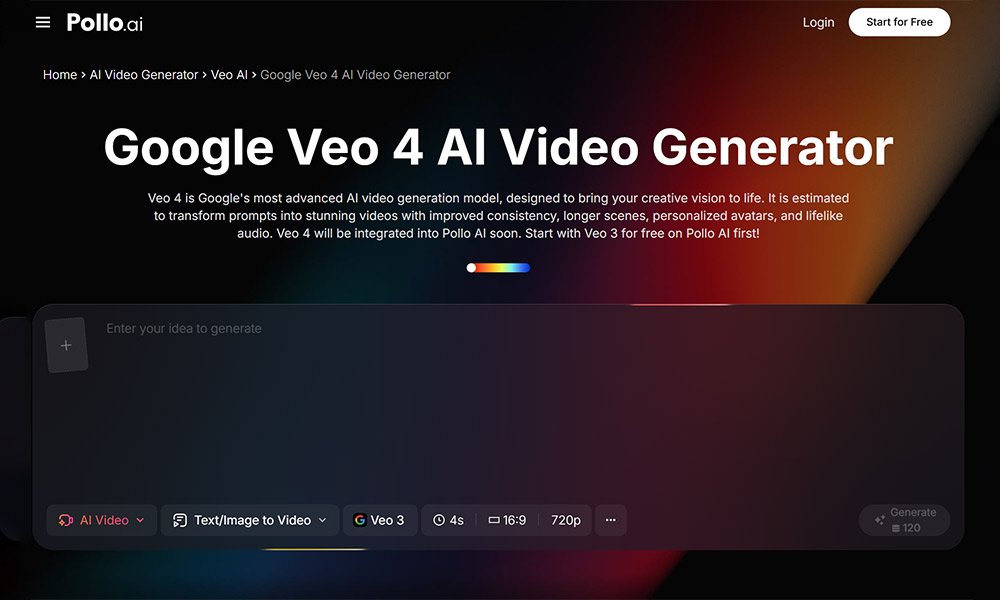
Speculation is fun, but most creators have projects shipping this week. The good news is that Pollo AI already aggregates the strongest production-ready models in one workspace, so there’s no need to wait for Veo 4 to start making serious work.
Google Veo 3.1 is still the polish leader for now. Native 1080p at 24fps, synchronized audio with dialogue, sound effects, and music, plus start/end frame control. Best suited for branded content, narrative shorts, and anything that needs that recognizable Google-grade finish.
ByteDance Seedance 2.0 is the current motion king. Character movement feels physically grounded, camera work feels intentional, and temporal consistency holds up across longer clips. Reach for it when you’re producing character-driven stories, sports footage, or anything where motion realism makes or breaks the shot.
Alibaba Wan 2.6 is the most flexible workhorse on the list. Text-to-video, image-to-video, reference-to-video, video extension, plus a full suite of editing tools. The Pro, Flash, and Spicy variants let you trade off speed against quality depending on the job, and Wan 2.7 with first/last-frame control is already on the horizon.
Kuaishou Kling O3 Pro brings physics-aware cinematic quality. Its MVL technology makes fabric, fire, water, and hair behave realistically, and built-in voiceover plus ambient audio rounds out the package. A strong pick for product videos and professional shorts where realism matters.
For creators working on a different end of the spectrum — animated explainers, B2B content, and stylized motion graphics rather than realistic video — Steve AI is also worth keeping in the rotation. It’s the right tool for SaaS demos and educational content where photorealism isn’t the goal.
What to Do Between Now and the Veo 4 Launch
The smartest move for creators right now isn’t to pause and wait. It’s to get fluent in the current generation of models so that when Veo 4 drops, you already know how to brief, iterate, and integrate it into a real workflow. The teams who’ll get the most out of Veo 4 in week one are the ones who’ve already been pushing Veo 3.1, Seedance 2.0, and Kling O3 to their limits.
Pollo AI makes that practical because every major model lives under one roof, with transparent pay-as-you-go pricing and no need to juggle separate accounts or API keys. When Veo 4 launches, it will appear in the same interface alongside the rest — no migration, no learning curve, just another option in the dropdown.
If the late-April timeline holds, we’re only weeks away from finding out whether Google can reclaim the top spot. Either way, the pace of progress in this space shows no sign of slowing, and the creators who keep experimenting will be the ones best positioned to take advantage of whatever comes next.