Every year, Airports Council International (ACI) World releases its definitive ranking of the world’s busiest airports, which is a closely watched measure of global aviation health, regional recovery, and the ever-shifting dynamics of air travel demand.
The 2025 ACI rankings, released on April 14, 2026, paint a picture of a resilient, rebounding industry that handled an estimated 9.8 billion passengers worldwide, which is a 3.6% increase over 2024 and 7.3% above 2019 pre-pandemic levels.
This blog takes a deep dive into each of the ten busiest airports in the world: who they are, what makes them extraordinary, and what the numbers reveal about the future of global aviation.
Key Statistics Of The World’s Top Busiest Airport
| Total global passengers (2025) | ~9.8 billion (+3.6% vs 2024; +7.3% vs 2019) |
| Top 10 airports combined share | ~9% of all global passenger traffic |
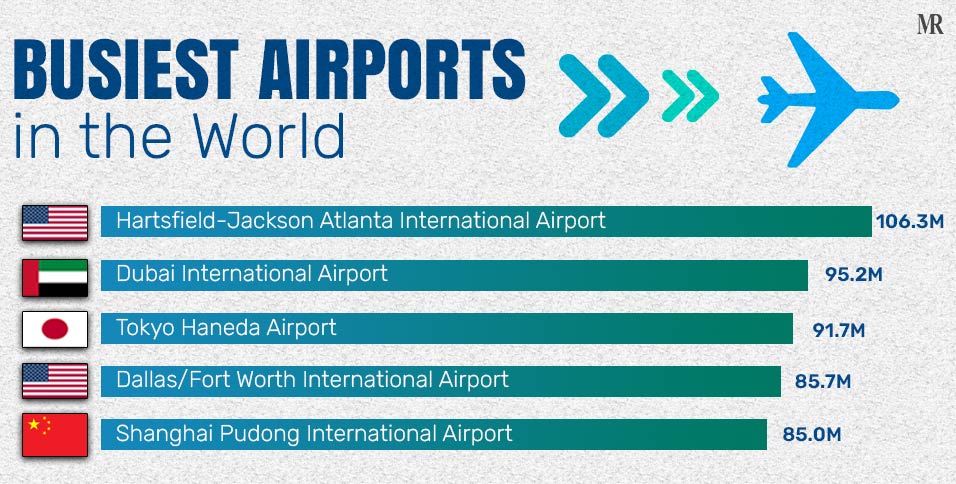
| Busiest airport (total passengers) | Hartsfield-Jackson Atlanta – 106.3 million |
| Busiest airport (aircraft movements) | Chicago O’Hare – 860,015 operations in 2025 |
| Fastest riser in top 10 | Shanghai Pudong – moved from 10th to 5th |
| Biggest mover up | Istanbul Airport — from 28th in 2019 to 8th in 2025 (+61.8% vs 2019) |
| Strongest international hub | Dubai International Airport – No. 1 for international passengers |
| US airports in top 10 | Atlanta (#1), Dallas/Fort Worth (#4), Chicago O’Hare (#6), and Denver (#10) |
| Domestic traffic share (US airports) | 80–95% of total passengers |
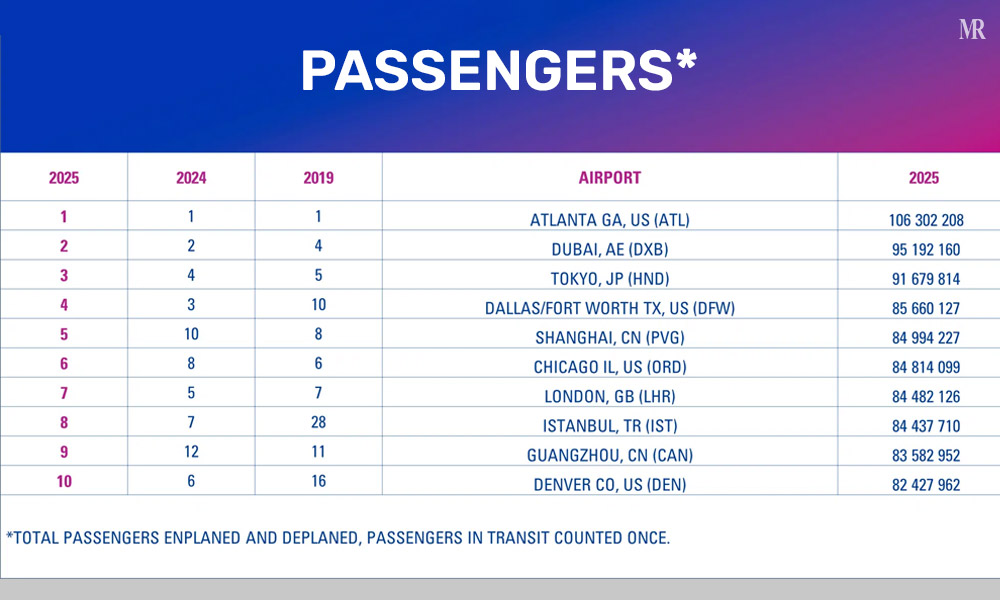
Top 10 Busiest Airports In The World (2025 Passenger Traffic)
Detailed Profiles Of The World’s Busiest Airports
1. Hartsfield-Jackson Atlanta International Airport (ATL) — Atlanta, USA
- Total Passengers: 106.3 million
- Rank: 1st (for the 26th consecutive year)
Hartsfield-Jackson Atlanta International Airport has retained the top spot of the busiest airport in the world for the 26th consecutive year. ATL processed 106.3 million passengers in 2025, making it not only the world’s busiest airport but also one of the most operationally efficient. It was the first airport in history to surpass 100 million passengers in a single year, a milestone it achieved years before any other hub.
Strategically positioned in the southeastern United States, ATL has a compelling geographic advantage: approximately 80% of the US population lives within a two-hour flight. This makes it the ideal hub for domestic connectivity, with nonstop service to more than 160 domestic and 80 international destinations spanning Europe, Asia, Africa, the Caribbean, and Latin America. Domestic passengers account for roughly 80–95% of its total traffic, reflecting Atlanta’s role as a key domestic hub.
Although ATL saw a modest -1.6% dip versus 2024 and remains slightly below its 2019 peak, its lead over second place remains enormous at over 11 million passengers.
2. Dubai International Airport (DXB) — Dubai, UAE
- Total Passengers: 95.2 million
- Rank: 2nd (Total Passengers) | 1st (International Passengers)
Dubai International Airport holds a unique dual distinction: it is the world’s second-busiest airport by total passengers and the undisputed number one for international passenger traffic. This makes DXB the single most important gateway for intercontinental travel on the planet.
DXB’s rise to prominence is inseparable from the growth of Emirates, the world’s largest international airline. The airline’s network of ultra-long-haul routes, connecting Asia, Europe, Africa, and the Americas through Dubai, has transformed DXB into the defining hub of global air travel.
With 95.2 million passengers in 2025, DXB continued to consolidate its status as the premier gateway for travelers between the East and West. Plans for the new Al Maktoum International Airport (Dubai World Central) are expected to eventually make Dubai the largest aviation complex in the world, capable of handling over 260 million passengers annually when fully operational.
3. Tokyo Haneda Airport (HND) — Tokyo, Japan
- Total Passengers: 91.7 million
- Rank: 3rd (up from outside top 3 in prior years)
Tokyo Haneda Airport rose to third place in the 2025 global rankings of the busiest airports, by processing 91.7 million passengers in 2025, which recorded over 21 million international terminal passengers in the April 2025–January 2026 period alone.
Haneda occupies a privileged location: it sits just 14 kilometres from central Tokyo, making it the preferred airport for business and frequent travellers. Its expansion in recent years has allowed it to handle a dramatically larger share of international traffic than at any point in its history.
According to official TIAT FY2025 statistics, total passengers across all categories reached over 21 million through the international terminal in just the first ten months of the fiscal year, with incoming passengers up 19–35% year-on-year across most months.
4. Dallas/Fort Worth International Airport (DFW) — Dallas–Fort Worth, USA
- Total Passengers: 85,660,127
Dallas/Fort Worth International Airport ranks as the 4th busiest airport in the world by serving over 85.6 million customers in 2025. They have risen from 10th place in 2019 to reach this height in just six years.
DFW’s is the primary hub for American Airlines, one of the world’s largest carriers and its route network is exceptional in its scope: passengers can access 193 domestic and 79 international nonstop destinations. Additionally, 19 cargo airlines provide worldwide freighter service, underpinning DFW’s identity as a premier cargo gateway.
The airport generated over $78 billion in annual economic impact for the North Texas region, one of the highest of any airport on this list. In terms of aircraft movements, DFW ranked 3rd globally in 2025 with 743,394 operations. DFW was alspo titled as the best airport in North America 2025
5. Shanghai Pudong International Airport (PVG) — Shanghai, China
- Total Passengers 84,994,227
- Rank: 5th (biggest mover in the top 10)
Shanghai Pudong International Airport jumped from 10th place to 5th in the global rankings as one of the world’s busiest airports in 2025. Powered by China’s accelerating recovery and policy shifts, Pudong’s ascent reflects the broader Asia-Pacific rebound that has reshaped global airport rankings.
Key drivers of Pudong’s rise include the easing of China’s visa policies, the resumption and expansion of international routes (the airport now serves 302 destinations across 54 countries, which is its widest global reach ever), and the boost from major events including trade exhibitions like the Canton Fair. The airport achieved its 26th consecutive year of safe operations in 2025.
6. Chicago O’Hare International Airport (ORD) — Chicago, USA
- Total Passengers: 84,814,099
- 2024 Rank: 8th | Aircraft Movements: 860,015 (World #1)
In 2025, Chicago O’Hare International Airport reclaimed the title of the world’s busiest airport by aircraft movements, recording 860,015 flight operations, equivalent to one takeoff or landing every 37 seconds, every day of the year. It had previously held the top spot as recently as 2019, and its return to number one in 2025 reflects a 10.8% increase in operations over 2024.
By total passengers, O’Hare climbed from 8th in 2024 to 6th in 2025 with 84,814,099 passengers, which is up 6.0% from 2024. O’Hare’s operational dominance stems from its eight-runway system, developed over 16 years and widely regarded as the most advanced airfield configuration of any civilian airport globally.
The airport serves nearly 280 destinations and has been ranked the most connected airport in the United States by the Official Aviation Guide (OAG) every year since 2017.
The airport’s passenger figure is just 0.2% above its 2019 level, indicating that O’Hare’s remarkable growth in 2025 is a genuine recovery milestone and not just a post-pandemic bounce.
7. London Heathrow Airport (LHR) — London, United Kingdom
- Total Passengers: 84,482,126
- International Passenger Rank: 2nd globally
London Heathrow has for decades been the gateway of choice for transatlantic and intercontinental travel, and its 7th-place ranking in total passengers understates its true significance to the global air travel system.
In terms of international passengers alone, Heathrow ranks 2nd in the world, behind only Dubai, a reflection of the UK’s deep integration into global trade and tourism networks.
In 2025, Heathrow processed 84,482,126 passengers, up just 0.7% versus 2024, but 4.4% ahead of its 2019 pre-pandemic level. The airport’s quarterly traffic data shows full-year 2025 numbers tracking around the 83–84 million range, with 2025 representing a new post-pandemic record.
8. Istanbul Airport (IST) — Istanbul, Turkey
- Total Passengers: 84,437,710
Istanbul Airport’s presence in the global top 10 busiest airports in the world is one of the most dramatic success stories in modern aviation infrastructure. Opened in April 2019, just months before the pandemic, IST has rapidly grown into a transcontinental mega-hub, processing 84,437,710 passengers in 2025.
Istanbul Airport’s +61.8% growth versus 2019 is by far the largest among all top 10 airports, reflecting both the ramp-up of a brand-new facility and Turkey’s surging role as a transit hub between Europe, Asia, Africa, and the Middle East. With an ultimate capacity planned to exceed 200 million passengers across multiple phases, Istanbul Airport is still in the early stages of its build-out.
The Airport is the primary hub for Turkish Airlines, which has grown into one of the world’s largest carriers by destinations served. Its unique geographic position, straddling Europe and Asia, makes it a natural connecting point for intercontinental itineraries that would otherwise require a detour through a Western European hub.
9. Guangzhou Baiyun International Airport (CAN) — Guangzhou, China
- Total Passengers: 83,582,952
Guangzhou Baiyun International Airport’s inclusion in the 2025 top 10 is one of the most remarkable comeback stories in global aviation. Having fallen to 57th place in 2022 at the height of China’s strict pandemic controls, the airport has vaulted from 12th in 2024 to 9th in 2025.
As of December 17, 2025, Baiyun’s annual passenger throughput exceeded 80 million for the first time in its history, with international passenger traffic surpassing 16.6 million — also a record. At 83,582,952 passengers in the final ACI count, its +9.5% year-over-year growth is the second-highest of any top 10 airport. International traffic surged more than 19% year-over-year, driven by synergies between major sporting events, trade exhibitions (including the Canton Fair), and targeted cultural tourism initiatives.
Infrastructure upgrades have been central to this growth. In 2025, the commissioning of Terminal 3 and the fourth and fifth runways established a new operational framework of three terminals and five runways.
10. Denver International Airport (DEN) — Denver, USA
- Total Passengers: 82,427,962 (all-time record)
Denver International Airport had a landmark year in 2025, recording 82,427,962 passengers, an all-time record since it opened on February 28, 1995. While the +0.1% change versus 2024 indicates a near-plateau, the +19.4% growth against 2019 figures tells a powerful longer-term story of sustained expansion.
DEN is the 4th busiest airport in the United States and, per its own official data, the 10th busiest in the world. It serves as the primary economic engine for the State of Colorado, generating $47.2 billion in annual economic impact. In 2025, DEN served 231 nonstop destinations, including 4.8 million international passengers (up 4.8% vs 2024), and handled 732 million pounds of cargo.
DEN operates on 53 square miles (34,000 acres) of land, twice the size of Manhattan, and large enough to contain Hartsfield-Jackson Atlanta, Chicago O’Hare, Los Angeles International, and Dallas/Fort Worth collectively within its property boundaries. It is the largest airport site in North America and the second-largest in the world.
Other Notable Rankings Of World’s Busiest Airports In 2025
- Busiest Airports By International Passengers
The top 3 busiest airports for international passengers were Dubai International (1st), London Heathrow (2nd), and Seoul Incheon (3rd). The top 10 international passenger airports collectively handled 17% of all global international traffic. This concentration underscores the critical importance of a small number of mega-hubs to the global air travel network.
- Busiest Airports By Aircraft Movements
Chicago O’Hare led the world busiest airports by aircraft movements with 860,015 operations, followed by Atlanta (807,625), Dallas/Fort Worth (743,394), Denver (701,335), Las Vegas Harry Reid (586,046), Los Angeles (580,996), Charlotte Douglas (574,193), Shanghai Pudong (557,046), Guangzhou Baiyun (550,512), and Istanbul (549,309). The dominance of US airports in this ranking reflects the enormous scale of domestic air travel in the United States.
- Busiest Airports By Air Cargo
Global air cargo reached approximately 128.9 million metric tonnes in 2025, up 2.9% year-over-year. The top busiest cargo airports accounted for roughly 26% of global volumes. Hong Kong International retained the top cargo spot, followed by Shanghai Pudong in 2nd place, with Anchorage (Ted Stevens Anchorage International) rising to 3rd — a reflection of its unique geographic position on trans-Pacific cargo routes.
Global Aviation Industry In 2025
Now that we have discovered the busiest airports in the world, it is worth understanding the landscape in which these rankings emerged.
Several macro-level forces shaped air traffic patterns in 2025:
- Global GDP grew approximately 3.0–3.2% in 2025. This was above expectations but below historical norms, with trade tensions and policy uncertainty creating headwinds for air travel demand.
- Jet fuel prices fell roughly 13% year-over-year, and easing inflation boosted consumer purchasing power, underpinning strong passenger demand.
- International passenger traffic reached 4.0 billion in 2025, up 5.9% versus 2024 and 8.3% above 2019, the clearest sign of a full global recovery.
- Asia-Pacific markets were the standout growth story, driven by China’s accelerating outbound travel and the resumption of major international routes.
- Infrastructure constraints like aircraft delivery backlogs, air navigation limitations, US gov shutdown, and slot restrictions,capped growth at many established hubs.
- Geopolitical disruptions (airspace closures, regional conflicts) rerouted traffic and elevated operating costs at several hubs.
- Air cargo reached approximately 128.9 million metric tonnes, up 2.9% year-over-year, powered by e-commerce and restructured global supply chains.
These dynamics set the stage for the busiest airports in the world.
End Note
The 2025 global airport rankings, as released by ACI World on April 14, 2026, tell a story of recovery, resilience, and rebalancing. Atlanta holds firm at the top, a testament to the enduring strength of the US domestic aviation market. But the most compelling narratives belong to the Asia-Pacific resurgents: Tokyo Haneda climbing to third, Shanghai Pudong jumping five places, and Guangzhou Baiyun completing a near-miraculous recovery from 57th to 9th.
Global aviation has not just recovered from the pandemic, it has surpassed pre-pandemic levels. Yet the industry faces real structural challenges: aging infrastructure, constrained airspace, aircraft delivery backlogs, and the mounting pressure of decarbonization commitments.
The airports in this ranking are not merely the busiest — they are the investments, the institutions, and the infrastructure decisions that will shape how the world moves for the next generation.
Know a travel enthusiast or someone who loves aviation stats? Share this blog on the busiest airports in the world with them and spark a conversation on how global travel is evolving.
Important Note: ACI World notes that initial rankings data may differ slightly from the full confirmed rankings expected in July 2026, which will be based on detailed submissions from over 2,700 airports worldwide. All data cited in this blog is sourced directly from official airport press releases, TIAT official statistics, and the ACI World April 14, 2026 rankings announcement.
Maria Isabel Rodrigues