Have you ever wondered which countries have free healthcare in the world?
Healthcare is essential, but millions worldwide still lack access to quality care.
According to the World Health Organization, approximately 60% of the global population lacks access to essential health services.
Furthermore, while the US Government shuts down due to healthcare challenges, numerous countries worldwide have successfully implemented universal healthcare systems, ensuring that health is recognized as a human right, not a privilege.
This blog explores the top 10 countries with free healthcare and the world’s leading universal systems, their working, benefits, and challenges.
Understanding Free Healthcare vs Universal Healthcare
The terms “free” and “universal” are often used interchangeably, but they have distinct goals and structures.
| Universal Healthcare | Free Healthcare | |
| Primary Goal | To ensure every individual’s healthcare needs are met, with coverage for at least 90% of citizens. | To ensure all citizens can access healthcare with minimal or no direct cost at the point of service. |
| Funding Model | Funded through a mix of government revenue, private insurance, and patient out-of-pocket payments. | Funded almost entirely by the government through taxes, with no direct cost to patients. |
| System Structure | Can be a single-payer, multi-payer, or hybrid system involving public and private entities. | Typically a type of single-payer system where a government entity is responsible for funding medical services. |
In practice, most “free” systems are a type of universal healthcare funded by taxpayers. While you may not pay at the doctor’s office, the funding comes from taxes you and your fellow citizens pay.
Understanding Healthcare Funding Models
Universal coverage can be achieved through different funding models. The two most common are:
- Single-Payer Healthcare:
This model guarantees healthcare as a human right by replacing multiple for-profit insurance companies with a single government entity responsible for funding medical services. Countries like Canada and Sweden use single-payer systems.
- Multi-Payer Healthcare:
This model involves multiple insurance providers, including both private and public entities, that share the responsibility for funding healthcare services. Germany and France are examples of countries that combine private and public options to ensure coverage for all.
List Of Countries With Free Healthcare Services In The World (Alphabetically)
| 1. Australia | 13. Germany | 25. Norway |
| 2. Austria | 14. Greece | 26. Portugal |
| 3. Bahrain | 15. Hong Kong | 27. Singapore |
| 4. Belgium | 16. Iceland | 28. Slovenia |
| 5. Brazil | 17. Ireland | 29. South Korea |
| 6. Brunei | 18. Israel | 30. Spain |
| 7. Canada | 19. Italy | 31. Sweden |
| 8. Chile | 20. Japan | 32. Switzerland |
| 9. Cyprus | 21. Kuwait | 33. Taiwan |
| 10. Denmark | 22. Luxembourg | 34. United Arab Emirates |
| 11. Finland | 23. Netherlands | 35. United Kingdom |
| 12. France | 24. New Zealand | 36. Uruguay |
While dozens of nations offer universal coverage, here are 10 countries renowned for the quality and accessibility of their systems:
The Top 10 Countries With Free Healthcare Facilities
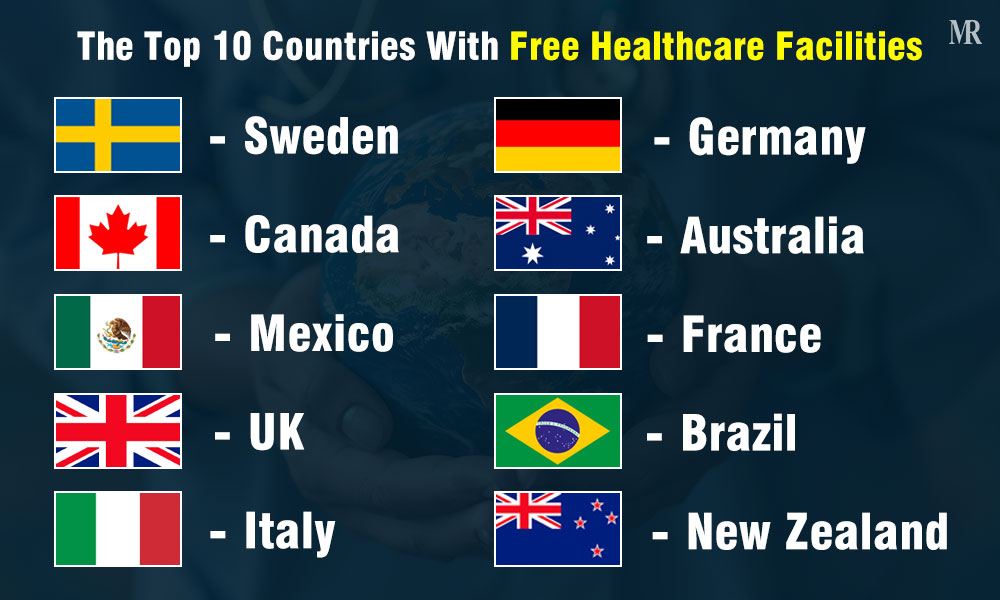
1. Sweden
Sweden stands at the top of the list of free healthcare countries. The Swedish health care system is distinguished by high standards of quality care and above-average healthcare spending.
- Types of Healthcare Services Provided: Comprehensive coverage, including primary care, specialist care, emergency services, in-patient and out-patient services, and mental health care.
- Healthcare System Used: Primarily publicly funded through taxes, overseen by regional councils.
2. Canada
Canada’s publicly funded health care system is a body of socialized health insurance plans administering coverage to all Canadian citizens and permanent residents. Canada has a remarkably high life expectancy rate, which many associate with the expertise of its health care system among countries with free healthcare.
- Types of Healthcare Services Provided: Medically necessary services provided free of charge, including hospital stays, physician visits, and diagnostic tests.
- Healthcare System Used: Publicly funded through a mix of federal and provincial programs, known as Medicare.
3. Mexico
Mexico guarantees access to healthcare as a constitutional right. In 2023, the government launched IMSS-Bienestar, which replaced the old INSABI system, to provide universal health services for uninsured citizens. This program covers millions of people, especially in rural and underserved areas, making Mexico a unique example of universal healthcare in Latin America.
- Types of Healthcare Services Provided: Public, private, and social security healthcare services.
- Healthcare System Used: Publicly funded through taxes and social contributions, with IMSS-Bienestar delivering universal healthcare to those without employer-based coverage.
4. United Kingdom
Healthcare in the UK has proven to be reliable and beneficial. Migrant workers and citizens benefit equally, making it a major destination for healthcare migration. The National Health Service (NHS), Scottish and Northern Ireland state programs offer many options for emergency medical treatment.
- Types of Healthcare Services Provided: Primary care, emergency services, and various specialist services are provided free at the point of use.
- Healthcare System Used: Publicly funded system, mainly through general taxation.
5. Italy
The healthcare system in Italy is a regionally established national health service recognized as Servizio Sanitario Nazionale (SSN). It grants coverage to all citizens and residents, with public healthcare largely free of charge.
- Types of Healthcare Services Provided: Coverage includes general practitioners, hospitals, specialist services, and subsidized medications.
- Healthcare System Used: Regionally administered universal public healthcare system.
6. Germany
The healthcare system in Germany is very exceptional but costly. Health insurance is compulsory, and most expatriates have it added to their employment contracts. It remains one of the wealthiest countries with free healthcare globally.
- Types of Healthcare Services Provided: Public and private healthcare services, including hospitalization, outpatient care, and rehabilitation services.
- Healthcare System Used: A multi-payer system combining statutory health insurance and private health insurance.
7. Australia
Australia’s healthcare system has two main sections: the public health system and the private health system. A collaboration of private health insurance, Medicare, and personal payments covers the medical costs of a patient. This gives Australian residents free treatment in public hospitals. As one of the top free Healthcare providers, it attracts many immigrants.
- Types of Healthcare Services Provided: Public hospital care, general practice services, and additional private insurance options.
- Healthcare System Used: Medicare, supported by private health insurance for additional services.
8. France
France has its state-run and private hospitals, and both maintain a similar degree of supremacy. While having private health insurance isn’t necessary, it is advisable to have it when you’re living in France.
- Types of Healthcare Services Provided: Public and private hospitals provide general and specialized healthcare.
- Healthcare System Used: A universal health insurance system shared between the public and private sectors.
9. Brazil
Brazil offers free healthcare to all residents free of charge at the point of service through its public system, Unified Health System (Sistema Único de Saúde or SUS). Meanwhile, private insurance covers about 25% for faster or additional services.
- Types of Healthcare Services Provided: Primary care, specialist care, hospitalization, surgery, mental health, vaccinations, and some free prescription drugs.
- Healthcare System Used: Universal, tax-funded, decentralized system financed by tax revenues and social contributions from the Federal, State, and Municipal governments.
10. New Zealand
The healthcare system in New Zealand is state-sponsored and of very high quality. It is financed through taxes and gives no-cost or subsidized medical treatment for residents. It’s one of the well-regarded Countries With Free Healthcare in the Pacific region.
- Types of Healthcare Services Provided: Public services for hospital and specialist care; private health insurance for quicker access.
- Healthcare System Used: Publicly funded healthcare system primarily through taxation.
Do Countries Have Free Healthcare for Foreigners?
If you are traveling or moving abroad, your access to these systems depends on your status:
- Tourists:
Generally, no. As a tourist, you will not be covered by a country’s national health plan (with rare exceptions for emergencies, like in Brazil). It’s crucial to have travel insurance.
- Legal Residents & Expats:
Yes, in most cases. If you are a legal resident, an expat on a work visa, or a registered long-term resident, you can typically enroll in the national healthcare system after completing the necessary paperwork. You will pay into the system through taxes or social security, just like a citizen.
- International Students:
Often, yes. Many countries require international students to enroll in the national health plan or show proof of equivalent private insurance as a condition of their student visa.
Potential Challenges in Universal Healthcare Systems
While these systems provide incredible benefits, they are not without challenges. Common criticisms include:
- Longer Wait Times: For non-emergency procedures or specialist appointments, patients in some countries may face longer wait times compared to private-payer systems.
- Tax Burden: Providing healthcare to an entire population is expensive and requires a significant financial commitment through taxation.
- Government Bureaucracy: Centralized, government-run systems can sometimes be slow to adopt new technologies or reforms, and administration can be complex.
Conclusion
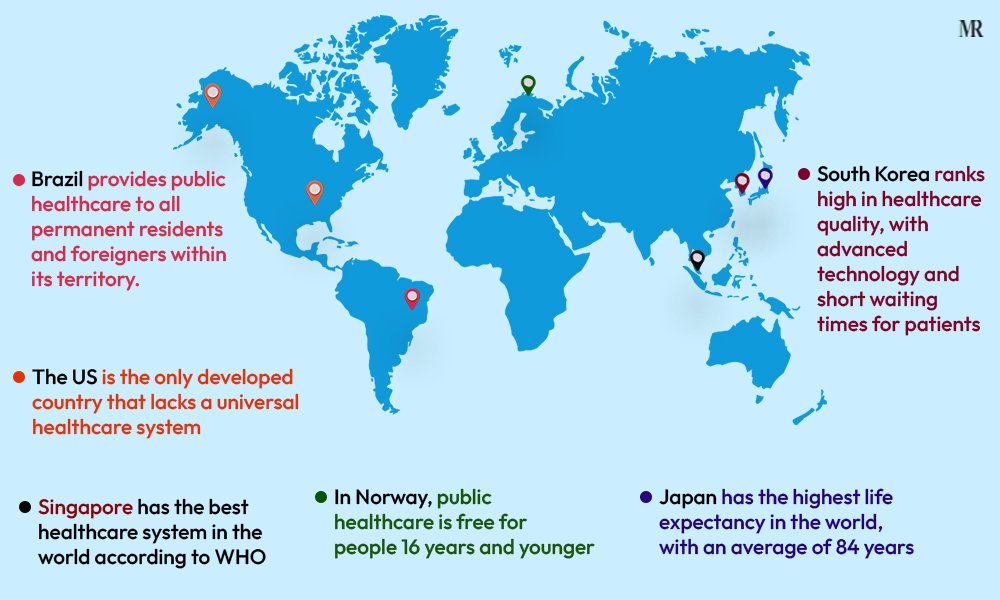
The United States is the only major industrialized country that does not offer universal healthcare.
Moreover, amidst the ongoing US government shutdown and debates about whether healthcare is a right or a privilege, these countries show that universal coverage is possible and sustainable.
While each system has a unique approach to funding and delivery, they all share a common principle: health is a human right, not a commodity.
By spreading costs across society, they ensure that no one has to face a medical crisis and a financial crisis at the same time.
Frequently-Asked Questions on Free Healthcare
- How many countries have free healthcare in the world?
Answer: Fully free healthcare is rare, but most developed nations cover essential services through public funding. Except for 43 countries, all other countries have free healthcare in the world.
- What country has completely free healthcare?
Answer: Brazil is the only country that has completely free healthcare. They provide public healthcare to all permanent residents and are one of the countries with free healthcare for foreigners within its territory through the National Healthcare System, called the Unified Health System (SUS).
- What countries don’t have free healthcare?
Answer: Afghanistan, Nigeria, Iran, Yemen, and the US are some of the countries that don’t have free healthcare. The United States is the only major industrialized country that does not offer universal healthcare.
- Why doesn’t the United States have universal healthcare?
Answer: The U.S. has a complex, multi-payer system that is primarily employment-based and dominated by private insurance companies. The path to universal healthcare has been blocked by historical, political, and cultural factors, including a strong private insurance lobby and a political emphasis on free-market principles.
- Can I travel to another country just to get free medical treatment?
Answer: Generally, no. This is known as “medical tourism,” and universal healthcare systems are designed for residents who contribute to the system. You typically need to prove legal residency to be covered.