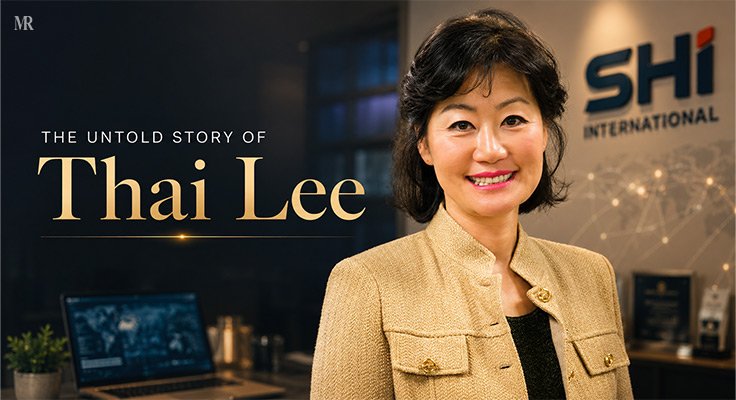
In the era of Influencer entrepreneurs, public-figure CEOs and viral-led businesses often get the spotlight. Yet, some of the most successful business leaders quietly work and build powerful companies behind the curtain. Thai Lee is one of them.
Instead of building a personal brand or chasing media publicity, Lee relied on operational discipline and long-term market vision. Over three decades, she quietly scaled SHI International from a defunct, small-scale operation into a global IT powerhouse that generates $15billion in annual revenue.
What makes her growth remarkable is that she is a self-made entrepreneur who built her empire without Silicon Valley venture capital or elite industry connections. By prioritizing customer satisfaction and sustainable growth over quick tech valuations, Lee created an enterprise blueprint that redefines modern tech leadership.
Who Is Thai Lee?
Thai Lee is a self-made billionaire entrepreneur and the CEO and President of SHI International. She is widely known for transforming a small software reseller into a global IT powerhouse serving various healthcare systems, universities, and government agencies.
Her contributions have also gained national attention. Thai Lee was listed on the Forbes 400 list in 2025 at number 192, and she was ranked #509 among the world’s billionaires by Forbes in 2026. These rankings reflect her impact in the business and technological sectors.
Born in Bangkok, Thailand, to South Korean parents, Lee spent her childhood moving between Thailand, South Korea, and the United States due to her father’s career as an economist. This cross-cultural upbringing forced her to adapt quickly to new environments, a trait that later shaped her flexible corporate leadership style.
Thai Lee Education That Shaped Her Leadership
Thai Lee’s academic journey is equally impressive.
She graduated from Amherst College with a BA in Economics before earning her MBA from Harvard Business School in 1985.
More importantly, she became the first Korean woman to graduate from Harvard Business School.
Early Career Before SHI International
Before becoming the head of SHI International, Thai Lee had several corporate and consultancy positions, which gave her a better understanding of technology markets and business processes.
She worked for organizations including American Express and Procter & Gamble. She gained experience in strategy, operations, and large-scale business management thanks to these roles.
Although these roles educated her in the business world, Lee finally came to the conclusion that she preferred to create something on her own rather than stay in a normal corporate setting.
The Beginning of SHI International
In 1989, Thai Lee and her former husband, Leo KoGuan, purchased a struggling software reseller called Software House International.
At the time, the IT reseller business was fiercely competitive and dominated by huge corporations. It was quite difficult for a woman entrepreneur to build a technological solutions company.
But Lee approached the business differently.
She saw that businesses were getting more and more reliant on software and computer systems. Yet, many companies had a hard time managing software licenses, buying the right computer equipment, and getting good technology support.
That vision, to fill the gap, became the foundation of SHI International.
The Business Strategy That Made SHI International Successful
Unlike many fast-growing tech companies, SHI International’s ability to adjust to shifting technological advances without losing customer service has been one of its greatest competitive advantages.
Over the years, SHI International grew through three major strengths.
1. Customer-First Relationships
Thai Lee knew that companies like reliability a lot more than fancy logos.
So SHI worked hard on fixing the problems that customers had instead of just trying to sell them stuff. This way, the company was able to make connections with big companies and government groups that lasted a long time.
Now SHI does business with companies like AT&T, Boeing, hospitals, schools, and government agencies.
Because of this, many organizations continue partnering with SHI for years with trust.
2. Operational Efficiency
SHI is successful for a lot of reasons, and one big reason is that they are really good at operations.
Thai Lee put in place systems that helped the company get IT products and services to people faster and cheaper than other companies.
While many businesses focused on rapid expansion without structure, SHI invested heavily in logistics, inventory management, and internal processes.
As a result, the company developed a reputation for consistency and reliability.
This operational discipline became especially important during economic downturns.
3. Long-Term Thinking
Many startups go after profits or quick exits. Thai Lee did something different.
Because SHI International remains privately owned, Lee could focus on long-term growth instead of quarterly shareholder pressure.
Instead of spending more on marketing or risky acquisitions, the company reinvested profits into growing services, infrastructure, and customer support.
This consistent business strategy helped SHI International to develop into one of the most recognized IT service providers in the sector over time. Forbes has also recognized the company’s steady development and workplace culture.
In the IT Software & Services category of Forbes’ 2026 ranking of America’s Best Midsize Employers, SHI came in at number 262. Furthermore, SHI was ranked #26 in the IT Software & Services category in Forbes’ 2025 list of America’s Top Private Companies.
What Does SHI International Do?
Today, SHI International provides a wide range of enterprise technology solutions.
The company plays a major role in helping organizations manage enterprise software licensing, cloud computing solutions, cybersecurity services, etc.
Here are the main services that drive SHI’s growth.
1. Enterprise Software Licensing
Large companies use software tools across different departments. Managing all those licenses can get really complicated and costly. SHI helps businesses keep track of software usage, stay compliant, and cut down on spending.
This service has become increasingly important as organizations rely more on cloud-based platforms and subscription software models.
2. Cloud Computing Solutions
As companies moved away from servers and started using the cloud, SHI International started to offer more cloud computing services. This helped organizations move their data and applications to the cloud in an efficient way. SHI International also helps with cloud solutions.
3. Cybersecurity Services
Cybersecurity is a big deal for businesses these days. Every year, there are data breaches, ransomware attacks, and other digital threats. This means companies need something more than just the basic security software for cybersecurity risks.
SHI has some advanced cybersecurity solutions, like finding threats, protecting endpoints and networks, and managing risks.
4. AI Infrastructure and Data Solutions
Artificial intelligence is changing industries from healthcare to manufacturing, and SHI International recognized this shift early. Because of this, the company increased its focus on AI infrastructure and enterprise data solutions that help businesses manage growing digital demands.
Today, SHI helps organizations use machine learning, predictive analytics, and automation more effectively. Reflecting its growing impact in the AI sector, SHI International also won the 2026 Artificial Intelligence Excellence Award from the Business Intelligence Group for its agentic AI and smart city frameworks.
With AI adoption accelerating worldwide, this sector is likely to become a major driver of the company’s future growth.
Thai Lee’s Leadership Style
Thai Lee’s leadership style is among the most impressive features of her achievements.
Compared to many current tech executives who place a high value on public interest, Lee is renowned for maintaining a calm and organized leadership style.
Experts in the field frequently describe her as:
- Highly analytical
- Customer-focused
- Operationally disciplined
- Long-term oriented
- Calm under pressure
The way SHI International is run really helped them stay on track when the economy was bad, and things were changing fast in the industry.
Employees and business partners often talk about how strong the company culture’s how consistent the management is when Lee is in charge.
Lee did not try to be a boss; instead, she worked on making SHI International a strong company that would last.
This choice ended up being one of the things that made Lee really good at her job, being the leader of SHI International.
Why Thai Lee Calls Herself an “Outsider”
During an interview with CRN, Thai Lee described herself as an “outsider” in the business world.
As a woman leading a major technology company in a male-dominated industry, she often found herself underestimated.
However, instead of trying to fit traditional leadership stereotypes, she built her own approach.
She focused on listening carefully, solving problems efficiently, and making decisions based on data rather than ego.
In many ways, being different allowed her to think differently.
That perspective helped SHI identify opportunities that competitors ignored.
SHI International’s Focus in 2026
As enterprise tech keeps changing, Thai Lee stays focused on the future of IT setup and digital change.
She keeps an eye on SHI International and its role in this changing tech world.
The company SHI International is doing well. Thai Lee’s wealth keeps growing.
SHI International is currently investing heavily in:
- Artificial intelligence infrastructure
- Cloud transformation services
- Cybersecurity platforms
- Hybrid workplace technology
- Enterprise automation
- Sustainable IT solutions
With businesses using AI systems and cloud computing more and more, SHI is becoming a technology partner for companies to update their systems.
SHI is good at changing with the market. That makes its role in the global IT world stronger.
Experts think SHI International’s plan for long-term growth could make it a bigger player in enterprise technology in the next ten years.
Lessons Entrepreneurs Can Learn From Thai Lee
Thai Lee’s success story offers several powerful lessons for entrepreneurs and business leaders.
- Discipline Matters More Than Attention
Many people believe success requires constant visibility. Thai Lee proved the opposite.
Her focus on execution and consistency helped her build a stronger company than many highly promoted startups.
- Customer Trust Creates Long-Term Growth
SHI International succeeded because customers trusted the company to solve real business problems. That trust created recurring business relationships that fueled long-term expansion.
- Adaptability Is Essential
The technology industry changes constantly. From software licensing in the 1990s to AI infrastructure in 2026, SHI survived because it continued evolving with the market. Businesses that refuse to adapt eventually become out of market.
Secret Behind Thai Lee’s Success
Thai Lee has shown us that if we want our business to grow, in a way, we need to be consistent and make smart choices. We also need to be able to change when technology changes.
Her story is an example for people who want to start their business and make it last. In an industry where everything is always changing, she has shown that being patient, able to adapt, and having a plan are still very important for business leaders. Thai Lee’s leadership is an example for entrepreneurs who want to build a company that will be around for a long time.
Vidya Jaisingpure
Frequently Asked Questions
- What is Thai Lee’s net worth in 2026?
As of 2026, Thai Lee’s estimated net worth is around $7.5 billion, primarily tied to her ownership stake in SHI International.
- Which industries does SHI serve?
SHI works across healthcare, education, finance, manufacturing, government, and enterprise technology sectors.
- Why is SHI considered a women-owned business?
Thai Lee is the majority owner and leader of SHI International. Because of this, SHI qualifies as a women-owned business enterprise.
Our Magazines →