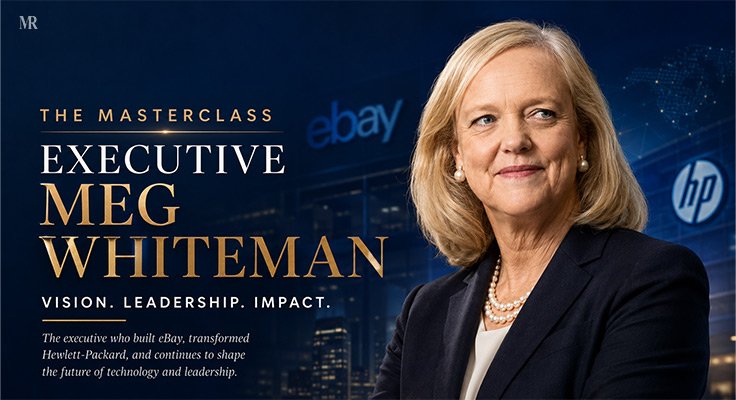
When people discuss the iconic leaders who shaped the modern internet, names like Jeff Bezos, Elon Musk, or Mark Zuckerberg usually dominate the conversation. But there is another powerhouse executive who fundamentally built the consumer internet and saved legacy American tech: Meg Whitman.
Meg Whitman is one of the most versatile, high-impact business leaders in United States history. Best known for taking eBay from a quirky, 30-employee startup selling collectibles to an $8 billion e-commerce giant, Whitman’s career is a masterclass in scale, adaptability, and high-stakes leadership.
But she didn’t stop at the internet. Whitman went on to lead Silicon Valley pioneer Hewlett-Packard through one of the largest corporate breakups in history, ran a record-breaking campaign for Governor of California, and even served on the global stage as a United States Ambassador.
Whether you are an aspiring entrepreneur, a business professional, or just a fan of incredible success stories, Meg Whitman’s journey provides the ultimate blueprint for top-tier leadership.
Meg Whitman’s Early Life and Education
Margaret Cushing “Meg” Whitman was born on August 4, 1956, in Huntington, New York, a historic coastal town on Long Island. Raised in a collaborative, high-achieving household, Whitman inherited a fierce work ethic and an adventurous spirit from her parents, Margaret Cushing and Hendricks Hallett Whitman Jr. Her mother, in particular, was a massive influence, famously telling young Meg to never accept “no” as an answer and to push past conventional boundaries.
As a student at Cold Spring Harbor High School, Whitman proved she was much more than a bookworm. She threw herself into competitive sports, competing intensely in field hockey, tennis, and lacrosse. Whitman often credits her time on those high school sports fields with teaching her the vital baseline frameworks she uses in corporate boardrooms today: structural teamwork, extreme physical and mental endurance, and strategic thinking under pressure.
Breaking Barriers in the Ivy League
After graduating high school in 1974, Whitman set her sights on the Ivy League. She enrolled at Princeton University with initial plans to become a medical doctor. However, a summer job selling advertisements for a university magazine completely changed her career trajectory. She realized she had a natural skill for economics, sales, and consumer psychology.
She switched her major right away and graduated from Princeton in 1977 with a degree in Economics. To build up her leadership skills, she moved to Massachusetts to attend Harvard Business School, earning her M.B.A. in 1979. When she entered the business world, very few women held top executive positions. However, she had the perfect mix of vision, education, and determination to break through those corporate barriers.
Meg Whitman’s Early Career
Before becoming a Silicon Valley legend, Meg Whitman spent nearly two decades mastering operations, product marketing, and brand strategy at some of America’s most recognizable consumer companies. She didn’t jump straight into tech; she learned how real people buy real things.
- Procter & Gamble (P&G): Whitman began her professional corporate journey as a brand manager, working on legacy household goods like Ivory Soap. Here, she mastered the baseline mechanics of customer loyalty.
- Bain & Company: Seeking a more analytical challenge, she transitioned into corporate consulting, ascending the ranks at Bain & Company’s San Francisco office to become a Senior Vice President.
- The Walt Disney Company: In 1989, she joined Disney as the Vice President of Strategic Planning, where she helped spearhead the global retail expansion of the Disney Store chain.
- Stride Rite & FTD: Whitman continued to diversify her executive skills, serving as an executive at Stride Rite Shoes before taking the reins as CEO of FTD, the famous floral delivery network.
- Hasbro: Before making her leap into technology, she served as a general manager at Hasbro, where she was responsible for the global marketing of legendary children’s brands like Playskool and Mr. Potato Head. She even imported the popular UK children’s show Teletubbies into the United States.
This rich, multi-industry experience gave Whitman a massive operational advantage. She wasn’t just a tech enthusiast – she was a certified expert in consumer behavior and massive corporate scaling.
The eBay Era
In early 1998, a tiny, eccentric internet company caught Whitman’s attention. The business was called eBay, an online auction platform founded by software engineer Pierre Omidyar. At the time, the website had just 30 employees and was bringing in a modest $4 million in annual revenues.
To traditional Wall Street business leaders, a rough website where strangers bid on Beanie Babies and old collectibles looked like a risky hobby that wouldn’t last. But Meg Whitman saw the big picture. She realized that online shopping powered by a passionate community could become incredibly powerful. She accepted the job as President and CEO and moved out to California.
Scalability, Safety, and the Feedback Forum
When Meg Whitman took over eBay, she immediately went to work changing it from an unpredictable hobby website into a world-class online store. Her plan for growing the company focused on three main pillars:
- Upgrading the Infrastructure: In 1999, eBay suffered a sudden 22-hour website blackout. Whitman didn’t panic. She immediately hired top engineering talent from Silicon Valley, stabilized the server architecture, and re-engineered the user interface to handle millions of concurrent users.
- The Power of Trust: Whitman realized that an online marketplace cannot survive if buyers fear being scammed. She formalized the Feedback Forum, a revolutionary peer-review rating system that established transparency and personal accountability.
- The PayPal Acquisition (2002): Recognizing that physical check payments were slowing down business growth, Meg Whitman made a genius move by buying PayPal for $1.5 billion. This game-changing decision solved a massive problem for online shoppers: it made paying for things online safe, fast, and completely effortless.
When the devastating dot-com bubble burst in the early 2000s, wiping out hundreds of high-flying internet startups, eBay didn’t just survive; it flourished. Thanks to Whitman’s disciplined, consumer-first approach, the company became an absolute winner of the early internet age. By the time she stepped down in 2008, Meg Whitman was an international business legend.
Saving a Legacy: The Rebuilding of Hewlett-Packard
After a decade at eBay and a high-profile venture into state politics, Whitman returned to corporate tech in September 2011. She was appointed CEO of Hewlett-Packard (HP), a foundational tech pioneer that was severely struggling under declining PC sales, heavy corporate debt, and massive internal boardroom drama.
Whitman was brought in to save the iconic company from total irrelevance, and she executed one of the largest, most complex corporate turnarounds in American history.
The Historic Corporate Split
Realizing that HP had grown too massive, slow, and bureaucratic to effectively compete against fast-changing cloud-based competitors, Whitman made a bold, historic decision in 2015. She officially engineered the split of HP into two completely distinct, publicly traded entities:
- HP Inc. (HPI): Focused strictly on consumer-facing hardware, such as personal computers, laptops, and advanced printing systems.
- Hewlett Packard Enterprise (HPE): Focused on corporate computing, secure servers, cloud architecture, and data storage solutions.
Whitman took the reins as the CEO of HPE, aggressively cutting operational costs, shedding unprofitable legacy divisions, and shifting focus toward high-margin hybrid cloud software. Her quick and bold decisions saved the iconic brand from potential bankruptcy, stabilized its stock performance, and preserved tens of thousands of American jobs. She officially stepped down from her executive role at HPE in early 2018.
Political Career and Public Service
Meg Whitman’s career has never been restricted strictly to tech boardrooms. She has consistently sought out challenges in public policy and new digital formats.
The 2010 California Gubernatorial Campaign
In 2010, Whitman officially entered politics, running as the Republican nominee for Governor of California. Campaigning on a platform of fiscal discipline, job creation, and corporate-style government efficiency, her race became historic.
Demonstrating her deep personal commitment, Whitman spent approximately $144 million of her own fortune on the campaign, setting a record at the time for the most self-funded political race in U.S. history. While she ultimately lost the general election to seasoned Democrat Jerry Brown, her campaign firmly cemented her status as a powerful player in national politics.
The Quibi Experiment
In 2018, Hollywood mogul Jeffrey Katzenberg recruited Whitman to serve as CEO of Quibi, a high-profile mobile streaming startup designed to deliver premium, short-form video content under ten minutes long.
Backed by $1.75 billion from major Hollywood studios, Quibi launched in April 2020. However, the timing proved challenging. Arriving at the peak of the COVID-19 pandemic lockdowns when consumers were stuck at home looking at large television screens rather than commuting with mobile devices, Quibi struggled to acquire subscribers. Making a quick and bold executive choice, Meg Whitman and Jeffrey Katzenberg decided to close the company within six months, successfully returning hundreds of millions of leftover dollars to their investors.
Diplomatic Success: U.S. Ambassador to Kenya
In December 2021, President Joe Biden nominated Meg Whitman to serve as the United States Ambassador to Kenya. Politicians from Democrats and Republican parties strongly supported her, and the U.S. Senate voted 100% in her favor to approve her in July 2022.
As ambassador, Whitman completely redefined the traditional diplomatic role by treating her position like a true corporate partnership. Dubbed “The Silicon Savannah Champion,” she worked directly with Kenyan leadership and global corporations to bring American venture capital, supply chain infrastructure, and technology investments to East Africa. She successfully concluded her historic diplomatic service in late 2024 following the U.S. presidential election cycle.
Meg Whitman’s Net Worth
Meg Whitman’s decades of calculated corporate risks and high-level leadership have earned her immense financial success. According to Forbes, Meg Whitman’s net worth stands at $4.2 billion. This places her firmly among the top tiers of “America’s Richest Self-Made Women.”
The bulk of her multi-billion-dollar fortune is derived from her early stock options and equity holdings built up during eBay’s exponential growth decade, alongside lucrative executive tenures at HP and various public boards.
The Whitman Harbor Foundation
With massive wealth has come a deep commitment to philanthropy. Alongside her husband, Dr. Griffith Harsh IV (a prominent neurosurgeon), she runs the Whitman Harbor Foundation.
The foundation focuses its strategic giving on key sectors:
- Environmental Conservation: Substantial funding was directed to global ecological groups like The Nature Conservancy, where Whitman recently rejoined the Global Board of Directors to advance climate resilience.
- Higher Education: She gave millions of dollars to Princeton University, which helped build Whitman College, a special residential building where undergraduate students live on campus.
- Social Equality: Sustained funding for Teach For America, helping upgrade educational resources in low-income school districts across the country.
Leadership in the AI Era and Beyond
Meg Whitman is not done shaping the future of technology. Today, she is stepping directly into the roaring world of Artificial Intelligence by serving on the board of directors for CoreWeave, a top-tier AI cloud provider that powers the next generation of massive AI systems.
Looking at her whole journey, Meg Whitman’s career serves as the ultimate playbook for getting things done. She went from tracking household soaps as a young brand manager to becoming an internet pioneer, a corporate savior, and a national diplomat. Time and time again, she has proven that if you have a clear plan, a sharp focus, and the ability to adapt, you can conquer any industry in the world. Meg Whitman didn’t just climb the corporate ladder; she built a legacy that will inspire business leaders for generations to come.
Vidya Jaisingpure
Frequently Asked Questions (FAQs)
- What is Meg Whitman’s current net worth?
Meg Whitman’s net worth is estimated at $3.6 billion, making her one of the wealthiest self-made female executives in U.S. history. Her fortune stems largely from her early stock options at eBay and compensation from her corporate tech career.
- What is Meg Whitman most famous for?
Whitman is most famous for serving as the President and CEO of eBay from 1998 to 2008. She took the online marketplace from a tiny, 30-person company making under $5 million annually and transformed it into a global powerhouse generating billions in revenue.
3. What boards does Meg Whitman serve on today?
Whitman serves on the Global Board of Directors for The Nature Conservancy and sits on the board of CoreWeave, a prominent AI infrastructure and cloud computing company. She has previously served on boards for Procter & Gamble, General Motors, and Dropbox.
Our Magazines →