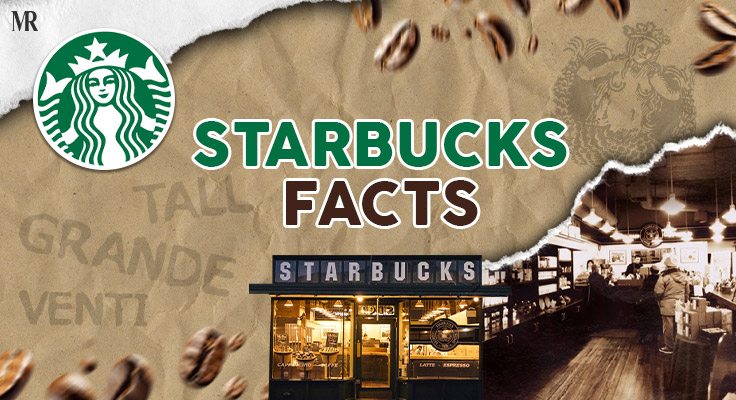
What if Starbucks had never evolved beyond selling coffee beans?
What if seasonal drinks were never a thing?
Behind the familiar green logo lies a story shaped by literature, design, culture, and deliberate business decisions. These Starbucks facts go beyond surface trivia to reveal how a small Seattle coffee retailer quietly transformed global coffee culture.
Starbucks is one of the most recognizable brands in the world, yet many people know surprisingly little about how it began, how it evolved, and why its influence extends far beyond coffee. While millions visit Starbucks daily, the deeper story behind the brand often goes unnoticed.
These facts give insight into the origins, design choices, cultural shifts, and business decisions that helped shape one of the world’s most influential coffee companies without relying on advertising alone, but on experience-led growth.
Starbucks Facts You Probably Didn’t Know
Firstly, let’s know why Starbucks facts continue to fascinate coffee lovers worldwide even today.
Starbucks is not just a place to grab a drink; it represents a shift in how people experience coffee, socialize, and even work. Understanding these facts explains how Starbucks redefined coffee consumption as a lifestyle habit, influencing everyday routines across cultures and age groups.
1. Starbucks Didn’t Begin as a Coffeehouse
One of the most surprising facts is that the company did not originally serve brewed coffee.
When Starbucks opened in 1971, it sold only coffee beans, tea, and brewing equipment. The idea of serving espresso-based drinks came later, fundamentally changing the brand’s direction after Howard Schultz observed Italian café culture in Milan during the early 1980s.
What most people don’t know is that Starbucks initially resisted becoming a café at all.
The founders believed serving drinks would distract from coffee purity. Howard Schultz had to leave the company, launch his own café chain (Il Giornale), prove the model worked, and then return to acquire Starbucks. Only then, in 1987, did Starbucks fully embrace the café concept.
2. The Name “Starbucks” Comes from Classic Literature
The name Starbucks was inspired by Moby-Dick, a famous novel by Herman Melville. The founders wanted a name that reflected the romance of the sea and early coffee trading traditions.
“Starbuck” was the name of the first mate in the novel, chosen deliberately to evoke heritage, navigation, and global trade rather than modern branding trends.
This literary reference gave the brand depth and timelessness long before storytelling became a mainstream marketing strategy.
3. The First Starbucks Store Opened in Seattle in 1971
Starbucks’ first store opened in Seattle’s Pike Place Market in 1971, a key moment in the early history of Starbucks.
This location is often mistaken for a café, but it originally functioned as a retail space for coffee beans and brewing tools, reinforcing Starbucks’ early identity as a specialty coffee retailer rather than a beverage chain.
This distinction explains why Starbucks scaled credibility first and consumption second.
4. The Siren Logo Has Changed Multiple Times
The Starbucks siren logo has undergone several transformations. Early versions featured a more detailed and less modest design.
Over time, the logo was simplified to make it more recognizable, adaptable for packaging, and culturally acceptable worldwide without altering its mythological origin.
Each redesign reflects how Starbucks balanced mythological identity with global cultural sensitivity as it expanded.
5. Starbucks Created a New Coffee Language
Terms like “Tall,” “Grande,” and “Venti” were popularized by Starbucks and are now widely understood by coffee drinkers globally, reflecting intentional brand identity choices.
This unique vocabulary helped standardize ordering while reinforcing the brand’s identity and subtly distinguishing Starbucks from traditional cafés.
What’s rarely discussed is that this language reduces price comparison.
By eliminating small, medium, and large, Starbucks shifted attention away from cost and toward experience, making premium pricing feel normal rather than questioned.
6. Starbucks Played a Role in Normalizing Ethical Coffee Sourcing
Starbucks introduced its Coffee and Farmer Equity (C.A.F.E.) Practices to promote ethical sourcing.
These standards focus on fair wages, environmental responsibility, and sustainable farming, influencing industry-wide practices and setting benchmarks adopted by other large coffee chains.
This positioned Starbucks as a standards-setter rather than just a buyer within the global coffee supply chain.
7. Starbucks Made Seasonal Coffee Culture Mainstream
The Pumpkin Spice Latte, introduced in 2003, changed how consumers viewed seasonal beverages.
It helped create an anticipation-driven coffee culture, where limited-time offerings become annual rituals rather than simple menu items.
Internally, Starbucks treats seasonal launches more like media events than menu updates.
Drinks are tested years in advance and designed around emotional calendars, turning seasons themselves into Starbucks-branded experiences rather than flavor experiments.
8. Starbucks Stores Exist in Unexpected Places
Starbucks locations can be found in airports, hospitals, universities, cruise ships, and even inside bookstores.
This strategic placement made Starbucks part of daily routines rather than a destination-only café, increasing brand visibility through convenience and accessibility.
Presence in routine-driven environments reinforced habitual consumption rather than impulse visits.
9. Starbucks Operates Tens of Thousands of Stores Worldwide
Starbucks operates over 35,000 stores across more than 80 countries as of recent public company reports.
This scale allows the brand to adapt menus locally while maintaining a consistent global identity, a rare balance among global fast-food chains.
Localization without dilution is a key reason Starbucks avoids brand fatigue at scale.
10. Starbucks Became a Cultural Symbol, Not Just a Coffee Brand
Starbucks influenced how people use cafés as social spaces, work environments, and meeting points.
The brand helped popularize the idea of the “third place,” neither home nor office, where people gather comfortably, especially in urban lifestyles.
This reframed cafés as lifestyle infrastructure rather than retail outlets.
Starbucks’ Global Influence Beyond Its Stores
Beyond its physical locations, Starbucks has shaped modern coffee habits, workplace culture, and consumer expectations.
From reusable cup initiatives to mobile ordering systems, its influence extends into sustainability efforts and digital convenience, redefining how people interact with cafés worldwide at scale.
These systems quietly reshaped consumer expectations for speed, personalization, and responsibility across the café industry.
Key Takeaways
Starbucks facts reveal that success often comes from redefining experience, not just selling products in highly competitive consumer markets.
What Starbucks truly mastered was turning everyday coffee into a meaningful ritual where time, space, and routine feel intentional. Its story shows how thoughtful branding, cultural awareness, and customer experience can elevate even the simplest product without changing its core purpose.
Enjoyed these Starbucks facts?
Share this with a fellow coffee lover you might change how they see their next cup.
Shadab Mestri
FAQs
- How is Starbucks different from traditional coffee chains?
Starbucks focuses on creating an experience, not just selling coffee. Its store design, ordering system, and “third place” concept distinguish it from conventional cafés.
- Does Starbucks roast its own coffee?
Yes. Starbucks sources green coffee beans globally and roasts them in company-operated roasting facilities to maintain flavor consistency and quality standards.
- Why are Starbucks drink sizes different from those of other cafés?
Starbucks adopted Italian-inspired size names to differentiate its brand and introduce customers to espresso culture, reinforcing a global café identity.
- Has Starbucks influenced other coffee brands?
Starbucks’ success influenced how cafés design menus, market seasonal drinks, and position coffee shops as social and work-friendly spaces worldwide.
- Is Starbucks more about branding or coffee quality?
Starbucks’ growth is driven by a balance of both consistent coffee quality supported by strong branding, customer experience, and global adaptability.
- Does Starbucks India have a brand ambassador?
No. In 2025, viral posts jokingly named Dolly Chaiwala as Starbucks India’s ambassador, but Tata Starbucks confirmed it was just a meme, not an official appointment.
Our Magazines →